

 Private Kenneth Noble Smith, 2590171, Wireless Section, Royal Corps of Signals - Ossett’s WW2 German Collaborator or the Victim of a Honey-Trap?
In August 1946, 29 year-old Kenneth Noble Smith from Ossett, an ex-German prisoner-of-war during WW2, was court-martialed at Gravesend, Kent for voluntarily aiding the Germans. He was accused of recording the BBC News radio transmissions at the German radio station Bureau-Concordia during the time he was a prisoner-of-war. The trial lasted two days and Smith pleaded ‘Not Guilty’. He had been under close arrest since March 1946, instead of being demobbed in January 1946 like the rest of his peer group.
At his court martial, Smith wore five medal ribbons and two good conduct stripes. He told the court that he had been educated at Ossett Grammar School, and that his parents, Mr. and Mrs. George Harry Smith were well respected in the town. He enlisted voluntarily in the Royal Corps of Signals (Wireless Section) in January 1940, and had been sent to the Middle East in December 1940, before being captured in the retreat from Tobruk in June 1942. He was imprisoned first at Benghazi, then in Italy, before finally being moved to Germany where he was liberated by American troops in April 1945.
Kenneth Noble Smith was born in Ossett on the 14th July 1917, the son of mill-hand George Harry Smith and his second wife, Amy Noble, who had married in Wakefield in 1916. Kenneth’s father George had been married previously. His first wife, Annie Mary (nee Cawthorne) died in early 1915, aged 32 years. The couple appear not to have had children. George H. Smith and Annie Mary married at South Ossett Christ Church on the 15th June 1907. He was then living at 23, George Street and Annie was from Manor Road, Ossett. George was employed as a mill hand. By 1911, they had no children and were living at 16, Albert Street, Ossett. George H. was now working as a card cleaner for a shoddy manufacturer.
By 1939, George H. Smith (born 28th April 1880) and his wife Amy (born 22nd November 1885) were living at ‘Sunroyd’, Broomcroft, South Street, Ossett with their only son Kenneth N. Smith. George H. Smith was now a foreman rag grinder at J. M. Briggs Sons, Runtlings Mills and Kenneth was working as a baker for Mr. A. Boulby, Baker and Confectioner, Park Street, Horbury.
Back at home in Ossett, Ken Smith had been a wireless enthusiast and because of his technical skills, he enlisted with the Royal Corps of Signals on the 29th January 1940. Smith was sent to Tobruk, Libya in North Africa in 1941 as part of a highly specialised, mobile wireless intercept unit (Y-Section), operating from armoured cars, and who were attached to Montgomery’s 7th Armoured Division (Desert Rats). Their role was to decode secret German communications right on the front line by getting as close as they could to the enemy positions.
Once decoded, these messages gave the British a huge advantage because they were then aware of German battle plans and the difficulties they were having with supplies of food and fuel during the North African campaign.
It was whilst Smith and his colleagues in Y-Section were intercepting German radio messages that they were captured near El Adem airfield, 15 miles south of Tobruk, on the 29th June 1942, by members of the German 21st Panzer Division. The Germans had recaptured El Adem airfield after the British captured it from the Italians in 1941. It seems the Germans treated their British captives well and they were given the classic line by a young German soldier "For you gentlemen, the war is over." Ken Smith said that the Germans ensured that he kept all his personal possessions, and treated him fairly, but he was sent to an Italian prisoner-of-war camp, PG 54 near Passo Corese, north east of Rome in Italy, between September 1942 and September 1943, where he was treated less well.
Just prior to the capture by the Germans in the Libyan desert, Smith’s unit had come across an abandoned British Army NAAFI wagon. Some of his colleagues got to the cigarettes and chocolate first, but the cash box was left, which Ken Smith promptly buried in the desert. Sadly, he was never able to get back and recover the loot.
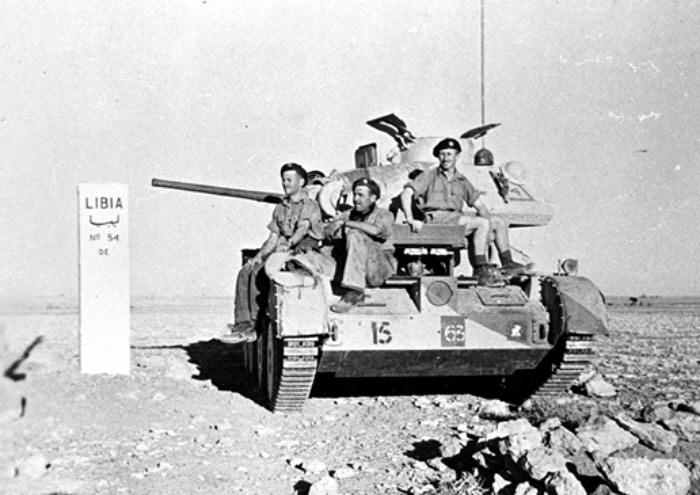
Above: British Armoured Car in Libya, 1941.
After Italy signed the armistice with the Allies in September 1943, Ken Smith was moved to Stalag VII-A PoW camp at Moosberg, near Munich, Germany between November and October 1944, where he worked latterly as an interpreter.
Whilst a prisoner-of-war at Stalag VII-A at Moosberg, Ken Smith became friendly with a German girl named Lotte, and he sent and received love letters from her. He was given transcripts of BBC News items from a British sergeant, who used to hear them outside, then secrete the messages in his shoes, and bring them into the camp. They used to read out this news to the other prisoners every night. Eventually, the Gestapo found the notes Smith had been sending to Lotte and also the BBC News messages.
He was arrested, sentenced to 9 months imprisonment, and sent to Stalag III-D Punishment Camp in Berlin and there taken before the German Authorities, who said that he was liable to be shot and threatened that he would get at least 10 years in a Concentration Camp. Under this threat, Smith agreed to go and work for the Nazis at the Bureau Concordia in Berlin. In mitigation, he said at his court martial "I would never have dreamed of doing what I did if this had not been hanging over my head."
Smith remained in Stalag III-D between October 1944 and April 1945, but managed to escape on the 6th April 1945 dressed in civilian clothing obtained for him by a Polish slave girl worker. He managed to board a train to Hanover, but was arrested there by the police, who eventually handed him over to the British Army authorities.
Germany Calling . . . Germany Calling . . . Germany Calling . . .
 Buro-Concordia was created by Joseph Goebbels Ministry of Propaganda to broadcast "black" propaganda from Berlin to Britain. Operated from 1940 to 1945, the speakers were British citizens recruited from people who were living in Germany when Hitler came to power. For some reason, these people were dissatisfied with the state of Britain and wanted to project that to their compatriots back at home. A few of them actively supported the Nazi regime. A lot of them were bored, disaffected and were paid quite considerably to deliver questionable propaganda broadcasts, mostly broadcast from Hamburg, but a few from Berlin. William Joyce or "Lord Haw Haw" (pictured left) was largely in charge of these people. Joseph Goebbels called him "the best horse in my stable" and was very proud of him. Whilst they had limited success, they fell short of what Goebbels expected of them.
After Hitler's death, in April 1945, William Joyce and his wife tried to escape from Germany to Denmark and then on to neutral Sweden, but he was apprehended in northern Germany by two British soldiers who recognised his voice as that of Lord Haw Haw. Joyce was shot by one of the soldiers and the bullet went though both the cheeks of his backside, and lodged in his thigh, leaving him with five painful wounds, from which he eventually recovered before being hanged for treason in England, despite that fact that William Joyce, "Lord Haw Haw" was born in New York in 1906.
The most important of the Buro-Concordia stations was the New British Broadcasting station, which purported to be operated from England and claimed to broadcast uncensored news, which in fact was pro-Nazi. The station operated on 7305 and 11960 kHz with programmes that were 30 minutes long, opening with "Loch Lomond" and closing with "God Save the King." The station was active until March 1945.
Smith said at his trial that one night at Buro-Concordia during an air raid, he caused a fire by wrapping curtains around a hot stove, and damage was caused, which the Germans estimated to amount to about 20,000 Marks.
Captain Rix (cross-examining) asked Smith if he had written to Lotte asking her to come to Berlin to live with him. Smith replied "Yes, frivolously. Actually, it was impossible for her to travel."
Captain E. A. Jones, defending declared that Smith did the work at Buro-Concordia under duress, and was no worse than thousands of other British prisoners who were forced to repair bomb damage and do other tasks in Germany. The Judge-Advocate (Lieut.-Colonel C. M. Cahn) said that the court would have to consider whether Smith undertook the work at Buro-Concordia to obtain extra freedom and whether the correct recording of news broadcasts would be of value to the Germans or not. They thought it worth paying Smith 250 Marks a month for his efforts, although perhaps they had intended to get something else out of him later.
In the event, Ken Smith was found "Not Guilty" and eventually released from custody, when he came back to live in Ossett. He married Dorothy Matthews in the summer of 1949 (registered at Lower Agbrigg, which at that time included Ossett). Perhaps because of the reports in the local press of his alleged collusion with the Nazis during WW2, Ken Smith moved from Ossett to live in Newcastle upon Tyne. He was awarded the British War Medal, the 1939-45 Star and Africa War Medal on the 3rd June 1950 for his service in the Libyan desert and was finally discharged from the Royal Corps of Signals on the 22nd December 1967.
Ken Smith was a licensed radio amateur (callsign G3RB), which was granted pre-WW2. When I was a schoolboy living in Ossett with my parents, I also passed the exams for my amateur radio licence (callsign G3VMW) and I remember talking regularly with Ken over the years, but always using high-speed morse code. He talked fondly about his time living in Ossett, but never mentioned his WW2 service.
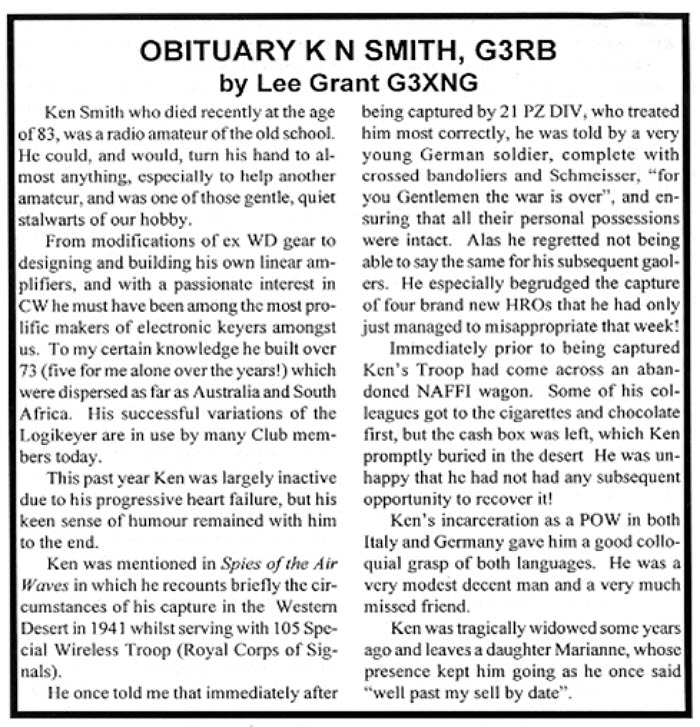
Kenneth Noble Smith died, aged 83 years, in the Tyneside area in summer 1999. The following obituary for Ken was published in the winter 1999 edition of FOCUS, the quarterly magazine of the First-Class Operators Club, of which we were both members.
References:
1. "Ossett Observer", August 17th 1946.
2. "Spies of the Air Waves: History of the Army Y Sections in the Second World War", by Hugh Skillen, privately printed edition (Sept. 1989), ISBN-10: 095151900X, ISBN-13: 978-0951519004
Note: This biography of Kenneth Noble Smith in is the work of Stephen Wilson. I am fully aware that this biography has been stolen, among with other work I've researched, then published on the Ossett website owned and operated by one Alan Leslie Howe, but passed off as his work! There's not much I can do about the theft of my work except to say I hope people judge Howe for his actions.